

 ₹https://branches.narayanaschools.in/locations/jalgaon/pimprala/narayana-schools-in-pimprala-jalgaon--6JsBz1/articles/catching-them-young-how-jalgaons-best-k-10-schools--2b89f8ec-8a0a-42d2-859c-4f60dc4cba79
Narayana Schools, Pimprala, jalgaon
Top CBSE School in Pimprala, Jalgaon, Maharashtra
Adjacent Sukruti Dream Homes, Nearby Ahuja Nagar, NH 53, Dule Road, Nearby Sukruti Suratna, Pimprala, jalgaon, maharashtra - 425001
Admission Enquiry 27-28
Narayana Schools Social Feeds in Pimprala, jalgaon
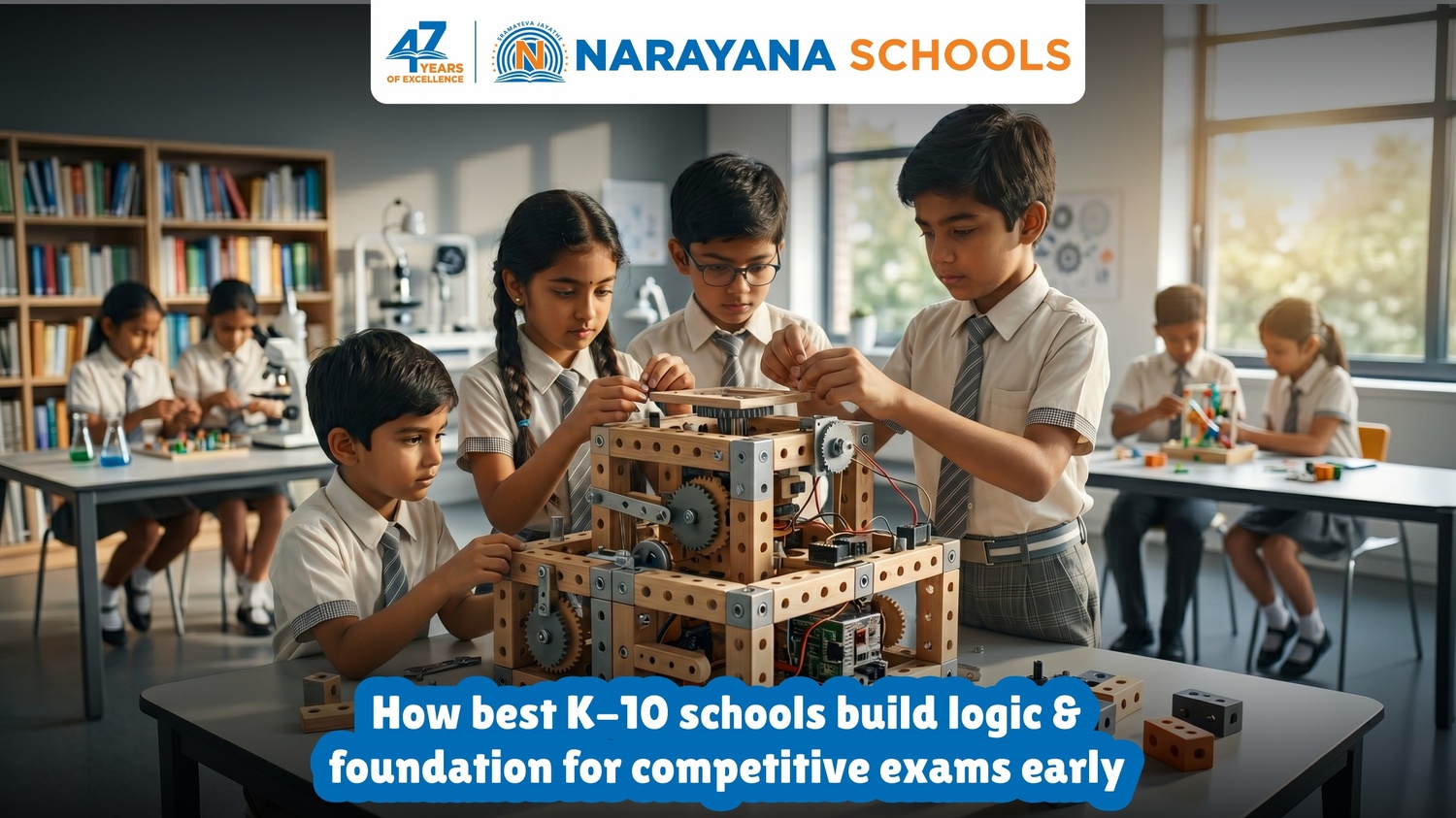
Catching Them Young: How Jalgaon's Best K-10 Schools Build Logic & Foundation for Competitive Exams Early
Cracking exams such as JEE, NEET, and the various national Olympiads is rarely the result of a single year of focused preparation. The thinking abilities those exams test, things like sharp analytical reasoning, careful problem-solving, and genuine conceptual understanding, are built far earlier than most parents tend to realise.
For parents in Jalgaon, picking the right K-10 school today involves more than scanning past board exam results. It involves finding a school that nurtures curiosity, develops logical reasoning, and quietly equips children with the skills they will need to thrive in academically demanding environments later on.
The strongest K-10 schools focus on building solid fundamentals from the early years, which gives students the confidence and capability to handle long-term academic challenges with relative ease.
Why Early Foundation Matters for Competitive Exam Success
Competitive examinations test far more than memorised facts. They evaluate:
Conceptual understanding
Logical reasoning
Analytical thinking
Problem-solving abilities
The student's ability to apply knowledge in unfamiliar contexts
None of these skills can be built through short-term coaching alone. Students who develop strong fundamentals through their school years often find competitive exam preparation noticeably easier when the time comes. The earlier children are introduced to concept-based learning and critical thinking, the more naturally these abilities mature over time.
Moving Beyond Rote Learning
Traditional, memorisation-heavy education has limits that show up later, particularly when students face higher-order questions.
Schools today are gradually shifting towards:
Concept-based learning
Activity-driven classrooms
Inquiry-based exploration
Practical application of knowledge
Structured skill development
This approach helps students understand the "why" behind concepts rather than simply remembering an answer to repeat in an exam. By the time they reach competitive examinations, that habit of thinking deeply about a problem becomes a genuine advantage.
Building Strong Foundations from the Early Years
The journey towards academic excellence begins quietly during the foundational and primary years.
Developing Curiosity and Observation Skills
Young learners are naturally curious. They ask questions, notice details, and want to understand how things work. A strong academic foundation encourages students to:
Ask meaningful questions
Investigate concepts on their own
Explore more than one possible solution
Develop scientific thinking patterns
These early habits form the basis of the analytical reasoning that competitive exams reward later.
Strengthening Core Academic Concepts
Subjects such as Mathematics, Science, and Language work as the building blocks for everything that follows. Strong conceptual understanding during the school years helps students to:
Solve complex problems confidently
Connect ideas across different subjects
Apply knowledge in unfamiliar contexts
Move into advanced topics without struggle
This becomes especially valuable when preparing for Olympiads and other competitive examinations, where the questions rarely come straight from the textbook.
The Importance of Logical Thinking in K-10 Education
Logic is one of the most valuable skills a child can develop for future academic success.
Students who build logical reasoning abilities early are typically better prepared to:
Analyse information critically
Recognise patterns and relationships
Solve problems they have not encountered before
Make well-considered decisions
Approach challenges in a systematic way
Modern classrooms now routinely include puzzles, projects, structured discussions, and reasoning activities that quietly strengthen these abilities through the school years.
Preparing Students for Competitive Exams Through Conceptual Learning
There is a common assumption that competitive exam preparation begins only in senior secondary school. In reality, the most successful students have usually been building their foundation for years.
Students who develop strong fundamentals during K-10 are often better prepared for:
Olympiads
NTSE and other scholarship examinations
JEE preparation
NEET preparation
Other competitive assessments that follow
Early exposure to analytical thinking allows students to approach advanced concepts with confidence rather than apprehension.
How Integrated Learning Supports Long-Term Success
An integrated curriculum helps students develop deeper understanding by linking learning across multiple subjects rather than treating each one in isolation.
Modern educational approaches now lean heavily into:
Concept clarity
Practical application
Experiential learning
Continuous assessment
Steady skill development
The combined effect is an academic ecosystem that supports both day-to-day school performance and the longer-term goal of competitive readiness.
The Role of Technology in Modern Learning
Technology has changed how students engage with concepts, and the change has been largely for the better.
Well-designed digital learning platforms allow students to:
Access personalised learning resources
Practise concepts independently
Identify their own learning gaps
Strengthen weaker areas at their own pace
Track academic progress over time
When used thoughtfully, technology complements classroom teaching rather than replacing it, and the result is improved learning outcomes overall.
Building Confidence Alongside Academic Excellence
Academic success is never determined by knowledge alone.
Students also need:
Self-confidence
Resilience
Clear communication skills
The ability to manage their own time
Emotional well-being
Schools that genuinely commit to holistic development end up producing students who are well-rounded enough to handle both academic and personal challenges as they grow.
How Narayana Schools Builds Strong Foundations for Future Success
At Narayana Schools, education is designed to develop academic excellence and the broader skill set required for future competitive success in parallel, not in sequence.
Through a structured learning journey across the eKidz, eChamps, and eTechno programmes, students are encouraged to build:
Strong conceptual understanding
Logical reasoning abilities
Critical thinking skills
Problem-solving capability
Independent learning habits
eKidz: Nurturing Early Learning and Development
The eKidz Programme is built around developing early cognitive, communication, social, and motor skills through play-based and age-appropriate learning experiences. The aim at this stage is to make learning feel natural rather than imposed.
eChamps: Building a Strong Foundation
For primary students, the eChamps Programme nurtures curiosity, creativity, communication skills, and conceptual understanding while building a strong academic foundation. Through activity-based and hands-on learning experiences, students actively engage with concepts, develop problem-solving abilities, and strengthen their understanding in meaningful ways. By the end of these years, students have developed confidence, essential life skills, and a strong grasp of how to learn, making the transition to the next stage smoother and more effective.
eTechno: Preparing Students for the Competitive World Ahead
For middle school (Classes 6–8) and secondary school (Classes 9–10) students, the eTechno Programme moves into deeper conceptual learning, analytical thinking, and structured academic preparation designed to prepare students for the competitive world ahead.
Key features include:
Subject-wise and class-wise workbooks designed to strengthen conceptual understanding and structured learning
A common teaching methodology implemented across Narayana Schools
Dedicated Olympiad preparation support
Adoption Calling, where a dedicated mentor responsible for up to 30 students connects with parents through fortnightly calls to provide progress updates, understand concerns, and support each student's overall development
Detailed performance analysis at regular intervals
Targeted Learner Support initiatives
Digital learning through nLearn
The programme is designed to help students build strong academic foundations, logical reasoning abilities, critical thinking skills, and problem-solving capabilities that support future success in competitive examinations and beyond.
Why Early Preparation Creates Long-Term Advantages
Students who are encouraged to think critically, ask deeper questions, and understand concepts thoroughly from an early age tend to develop a meaningful advantage as their academic journey progresses.
Rather than scrambling for competitive exam preparation in the final year, they have been quietly building the necessary skills across years of structured learning and guided development. This approach reduces the academic pressure that so often shows up in senior school and creates a much more sustainable path to success.
Final Thoughts
For parents in Jalgaon searching for the best K-10 schools, the focus should extend well beyond academic scores alone. The right school helps children develop logical reasoning, conceptual understanding, problem-solving abilities, and confidence from an early age, all of which compound over time.
At Narayana Schools, students are guided through a carefully designed learning journey that strengthens fundamentals at every stage. By combining academic excellence with critical thinking, skill development, and future-focused learning, the school prepares students not only for school examinations but also for the competitive opportunities that lie ahead.
When the foundation is built early and built well, students are far better placed to dream bigger, achieve more, and step into their future with quiet confidence.