

 ₹https://branches.narayanaschools.in/locations/-in-vadodara/-in-chhani/narayana-schools-in-chhani-vadodara--3dYCcv/articles/learning-by-doing-the-critical-shift-from-textbook-memorisation-to-activity-based-skill-tracking--c4e1391a-1b8e-4133-873a-877cc5ef0b58
Narayana Schools, Chhani, vadodara
Top CBSE School in Chhani, Vadodara, Gujarat
Survey No 104/1/2, TP No 46, FP No 56/3, Palasha Road, Nearby Narayan Green Vistas, Chhani, vadodara, gujarat - 390024
Admission Enquiry 27-28
Narayana Schools Social Feeds in Chhani, vadodara
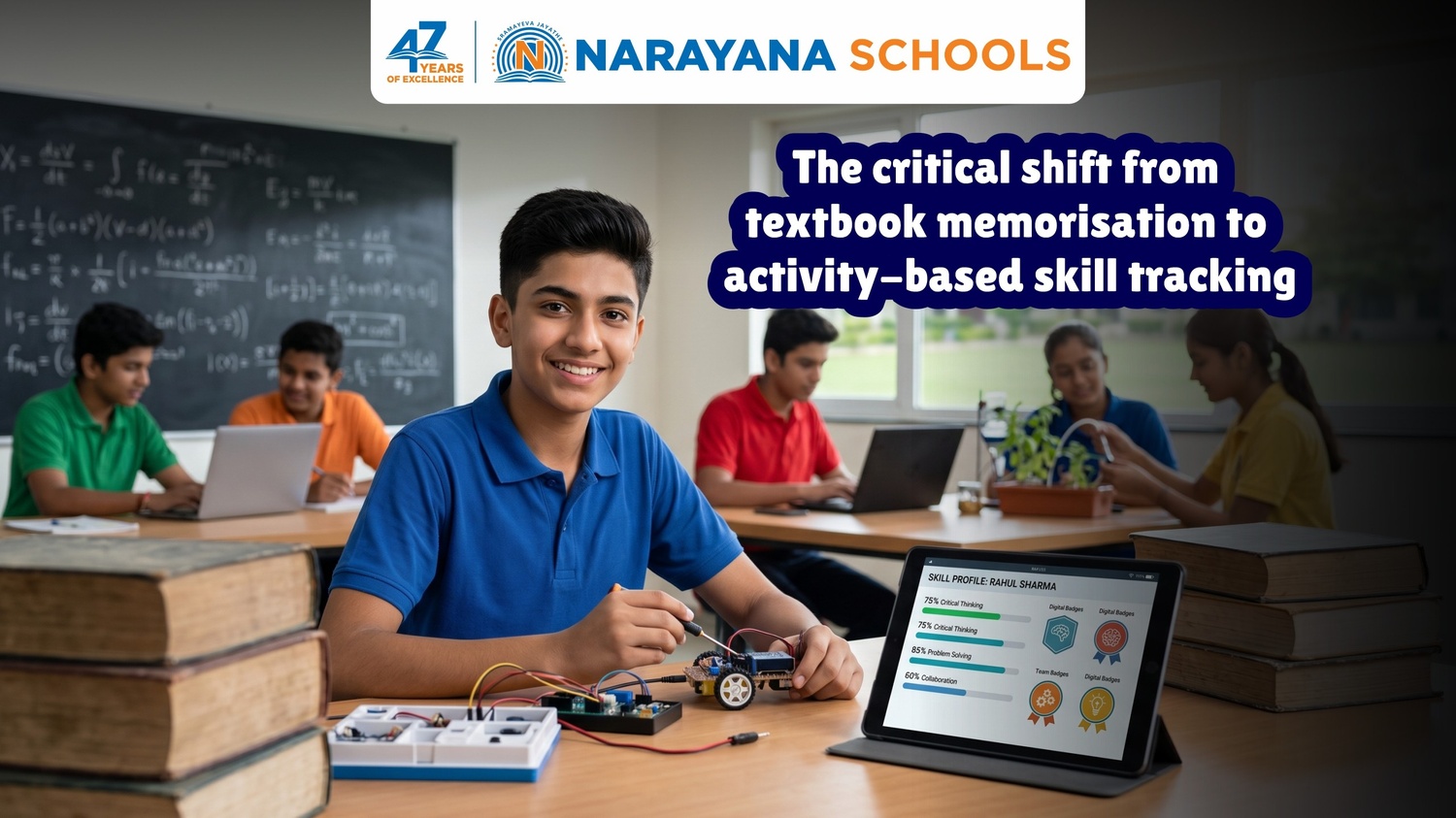
Learning by Doing: The Critical Shift from Textbook Memorisation to Activity-Based Skill Tracking
The way children learn is changing, and it is changing faster than most people realise. For decades, academic success in India was measured almost entirely by how well a student could memorise information and reproduce it during examinations. Knowledge still matters, but the world today asks for far more than strong recall.
Education frameworks such as the National Education Policy (NEP) 2020 have made the case clearly: future-ready learners need competency-based learning, critical thinking, creativity, collaboration, and problem-solving skills at the core of their education. In response, schools across India are gradually stepping away from traditional rote learning and moving towards activity-based learning and skill tracking, both of which prioritise genuine understanding over surface-level recall.
This shift from textbook memorisation to experiential learning is reshaping classrooms in real and visible ways. Students are no longer expected to sit quietly and absorb information. They are being invited to engage with it, question it, and apply it across every stage of school life, from the primary years right through to senior secondary.
Why Traditional Memorisation Has Limitations
Memorisation has its place. It can help students retain facts in the short term, particularly before an examination. However, it does not always translate into deep understanding.
Students who depend solely on rote learning often struggle when asked to:
Apply concepts in real-life situations
Solve problems they have not seen before
Think critically and independently
Collaborate effectively with peers
Adapt to changing circumstances
Decades of educational research point in the same direction: meaningful learning happens when students engage actively with concepts rather than simply committing them to memory. This is precisely why modern education increasingly focuses on building skills alongside academic knowledge.
What Is Activity-Based Learning?
Activity-based learning is an approach in which students learn through hands-on experiences, observation, exploration, projects, discussion, and structured practical activity.
Instead of reading about a concept in a textbook, the student is invited to participate in it.
Examples include:
Science experiments
Group projects
Role-play activities
Problem-solving exercises
Educational games
Art-integrated learning
Interactive classroom discussions
In short, the approach turns learning from a passive process into something the student actively shapes. The classroom feels less like a lecture hall and more like a place where things are being figured out together.
The Benefits of Learning by Doing
Improved Conceptual Understanding
When a child carries out an activity tied to a concept, they begin to grasp the "why" and the "how" behind it, rather than simply the "what". That deeper understanding stays with them. It also reduces their dependence on last-minute memorisation before tests.
Enhanced Critical Thinking Skills
Activity-based learning naturally encourages students to:
Analyse situations carefully
Ask their own questions
Evaluate outcomes
Explore more than one possible solution
These are skills students will need long after they leave school.
Increased Student Engagement
Children learn best through exploration and curiosity. Interactive lessons hold their attention, raise participation, and turn classrooms into spaces where learning feels like discovery rather than duty.
Better Communication and Collaboration
Many classroom activities involve working with others, discussing ideas, and presenting findings. Through that process, students learn to:
Express their ideas clearly
Listen actively rather than waiting to speak
Work together towards a shared goal
Respect perspectives that differ from their own
Stronger Problem-Solving Abilities
Real-world challenges rarely come with a single right answer. Activity-based learning gives students early exposure to the kind of creative, practical thinking those challenges require.
What Is Skill Tracking in Education?
As education becomes more competency-driven, schools are increasingly using skill tracking systems alongside traditional academic assessments.
Skill tracking measures a student's growth across several areas, including:
Communication skills
Critical thinking
Creativity
Collaboration
Leadership
Emotional development
Problem-solving abilities
Conceptual understanding
Rather than reducing a student to a single number on a marksheet, skill tracking provides a much fuller picture of how they are developing overall.
Why Skill Tracking Matters
Today's careers ask for a blend of academic knowledge and practical, transferable skills. Employers increasingly value qualities such as:
Adaptability
Teamwork
Clear communication
Innovation
Analytical thinking
When schools begin tracking these competencies from a young age, teachers are able to spot strengths early, address learning gaps before they widen, and offer personalised support that suits each child. The result is students who are prepared not only for examinations, but for the wider world that follows them.
The Role of Activity-Based Learning in Skill Development
Activity-based learning supports skill development almost automatically, because students are demonstrating their abilities in real time during classroom experiences.
For example:
Communication Skills
Presentations, group discussions, and collaborative projects help children develop both their speaking and their listening, often without them noticing it is happening.
Leadership Skills
Group activities frequently call on students to take initiative, make small decisions, and guide their peers. These are the earliest building blocks of leadership.
Creativity
Art integration, storytelling, design challenges, and innovation-based projects give students room to think originally rather than waiting for instructions.
Social and Emotional Skills
Interactive learning environments teach empathy, cooperation, resilience, and emotional self-awareness, the kinds of skills that shape character as much as academic capability.
Analytical Thinking
Hands-on classroom work invites students to observe carefully, investigate honestly, and evaluate information for themselves.
These are precisely the skills that traditional memorisation-based examinations have always struggled to assess.
How Modern Schools Are Transforming Learning
Forward-thinking schools across India are gradually reshaping their teaching methods to align with the way students actually learn best. This includes:
Experiential learning
Project-based learning
Inquiry-based learning
Art-integrated learning
Technology-enabled education
Continuous assessment and feedback
The combined effect is classrooms where students grasp concepts more deeply while also picking up the life skills they will carry into adulthood.
Narayana Schools' Approach to Experiential Learning
At Narayana Schools, learning is built to extend well beyond the textbook. The aim is for students to develop conceptual clarity, practical understanding, and lifelong skills through educational experiences that feel meaningful rather than mechanical. What makes the approach distinctive is that it does not end with the early years. Activity-based learning and skill development continue across every stage of the schooling journey, evolving in form as students mature but never being set aside in favour of pure memorisation.
This continuity is delivered through three core programmes: eChamps for the primary years, eTechno for the middle and secondary years, and the Senior Secondary programme for Classes 11 and 12.
eChamps: Activity-Based Foundations in the Primary Years (Classes 1 to 5)
The eChamps Programme covers Classes 1 to 5 and is where activity-based learning takes its first formal shape inside the classroom.
The approach is age-aware. For Classes 1 and 2, the teaching is built around activity-based learning that keeps the joyful, play-led spirit of the foundational years intact while introducing structured academic concepts. For Classes 3 to 5, the curriculum shifts towards experiential learning, giving children deeper engagement with ideas as their thinking matures.
Across both phases, eChamps places clear emphasis on:
Communication, social, and emotional skill development alongside academics
Group activities and collaborative projects that build cooperation and teamwork
The Learner Support Programme, which identifies individual learning gaps early and offers targeted help
A Common Micro Schedule that organises the curriculum into daily and monthly modules across all branches
Co-scholastic activities through clubs that link learning to real interests
The nSports Programme, which supports physical development alongside academic growth
This is where students learn that asking questions is welcome, working with others is normal, and applying what they have learnt is part of the everyday classroom experience.
eTechno: Hands-On Learning Through the Middle and Secondary Years (Classes 6 to 10)
The eTechno Programme picks up where eChamps leaves off and runs through Classes 6 to 10, which is when academic content grows in depth and the stakes around it begin to rise. Rather than retreating into textbook study at this stage, Narayana's approach goes the other way. The hands-on, applied style of learning expands.
The eTechno classroom is built around a 1+1 model that deliberately combines theory and practice, ensuring that students do not just learn concepts but actually use them. Practical experience is built into the academic infrastructure itself through:
State-of-the-art Robotics Labs, Computer Labs, and Science Labs that give students hands-on engagement with concepts across disciplines
The Olympiad Programme, which integrates practical applications and trains students to think critically and solve complex problems for national and international competitions such as ISMO, IOAA, ISCO, IPhO, IChO, and IBO
The NSS Space Settlement Contest, organised by NASA, which challenges students to develop innovative solutions for human settlement in space
CCE-guided projects integrated into the assessment system
Co-scholastic activities through clubs designed to promote interdisciplinary thinking and link academic knowledge to real-world applications
Performance tracking is just as deliberate. The Common Examination model, in-depth performance analysis delivered within three days of every exam, and Personalised Error Analysis and Correction together create a feedback system where students can see exactly where they stand and what they need to work on. The nLearn app, including its AI-powered personal tutor, complements classroom learning with adaptive practice and smart testing.
This is the stage where activity-based learning matures into something measurable, where skill tracking shifts from observation to data, and where students begin to understand themselves as learners.
Senior Secondary: Applied Learning in Classes 11 and 12
The Senior Secondary years are often the point at which schools quietly drop activity-based learning in favour of exam-focused drilling. At Narayana, the opposite happens. The pedagogies used in Classes 11 and 12 are explicitly active, and they draw directly from the formal frameworks the National Education Policy 2020 and the National Curriculum Framework 2023 have laid out for senior secondary education.
Teaching at this stage incorporates:
The Panchpadi framework from NCF 2023, which structures learning across five stages: Aditi (introduction), Bodh (understanding), Abhyas (practice), Prayog (application), and Prasar (extension)
Project-Based Learning as a core NEP 2020 pedagogy
Art-Integrated Learning across subjects
Flipped Classroom methods that move active engagement into class time and information delivery outside it
Critical Pedagogical Approach and other contemporary methods
These pedagogies sit alongside the focused academic preparation that Senior Secondary students need, including:
Regular mock board tests and competitive exam practice
Debates and group discussions that build articulation and confidence
Mentorship from experienced faculty
Interactive learning through nLearn, including live classes, learning videos, question banks, and detailed performance analytics
Career-oriented preparation for JEE, NEET, CA-CPT, UPSC, and other competitive examinations
The result is that even in Classes 11 and 12, when the pressure on outcomes is at its highest, students are still being taught to think, apply, debate, and create rather than only to memorise.
Skill-Building That Runs Across the Journey
Several Narayana initiatives stitch the three programmes together so that the activity-based, skill-building approach is felt as a single continuous experience rather than three disconnected stages.
The Adoption Calling Programme runs from eChamps through Senior Secondary, with a dedicated teacher sharing personalised updates with parents every fifteen days about academic progress, behaviour, and overall development.
The Disha Mental Wellness Programme supports emotional resilience, stress management, and counselling needs from the middle years onwards.
The Learner Support Programme identifies individual learning challenges across stages and provides targeted help.
nConnect keeps parents informed in real time across every programme.
The Olympiad Programme stretches academically inclined students from the middle years onwards through structured competitive preparation.
nSports supports physical development as an integrated part of school life, not an add-on.
The point of these programmes is that they are not bolted onto academic learning. They are the academic learning, working alongside subject teaching to ensure that students leave Narayana having developed both the knowledge and the broader competencies that will matter beyond the school gate.
Preparing Students for the Future
The future will belong to learners who can adapt, innovate, collaborate, and solve problems with confidence.
As educational priorities continue to evolve, the move away from textbook memorisation and towards activity-based skill tracking is becoming a central part of that preparation. What makes the difference, though, is when this approach runs continuously through the whole school journey rather than being limited to the early years.
Students who learn actively, by doing rather than only reading, across primary, middle, secondary, and senior secondary years are far better positioned to:
Understand concepts at a deeper level
Apply knowledge across new and unfamiliar contexts
Build essential life skills
Develop genuine confidence and resilience
Hold their own in competitive academic and professional environments
Final Thoughts
For parents in Chhani, Vadodara, choosing a school that genuinely prioritises experiential learning and skill development can make a meaningful difference to a child's educational journey. Academic excellence is important, but real success comes from the knowledge, the competencies, and the confidence required to navigate a world that does not stay still for long.
At Narayana Schools, the emphasis on activity-based learning, conceptual understanding, and holistic development runs across every stage of school life. From the activity-based foundations of eChamps in the primary years, through the hands-on practical depth of eTechno in the middle and secondary years, to the Project-Based and Art-Integrated pedagogies of Senior Secondary, students grow into active, capable learners rather than passive recipients of information. By balancing strong academic outcomes with steady skill-building across the entire school journey, Narayana Schools prepares students not only for examinations but for the longer journey that follows them.